Name: Titanium
Latin Name: Ti
Atomic Number: 22
Atomic Weight: 47.87
The element of titanium was discovered in 1791 in Cornwall by William Gregor (1761-1817) and named after Titans of Greek mythology (Titan meaning first-sons of Earth). It is naturally found in mineral deposites found occasionally in the Earth's crust. It has a high melting temperature of 1660-1670 degrees Celsius and boiling temperature of ~3287 degrees Celsius. It is also as strong (if not stronger) than steel and less than half its weight. It has a low density and high corrosion resistance so it will never rust no matter how long its under water/saltwater. It has the highest strength to weight ratio of any metal in the periodic table.
The shape of titanium's crystalline structure is similar to diamond (hexagonal) and is usually alloyed with other metals to improve an aspect(s) of it (e.g: Titanium-Aluminium alloy = lighter). When combined with trace amounts of Ruthenium, Titanium's strength increases by a hundredfold.
Titanium's uses vary but usually appear in things needing a light, strong material. Titanium is used in diving watches, regulators, normal watches, robotics, electronics, bikes, wires, camera cases, jewellery, building materials, springs, cups, pens, pans, glasses, screw drivers, telescopes, handcuffs, oddly shaped computer mouses, engines, shavers, knifes, welding masks, "money clips", cutlery, nuts, bolts, wrenches, and A LOT more. Titanium alloy is commonly used in aerospace facilities and on satellites.
The reason Titanium is my favorite element is because of it's strength and durability which makes it applicable to any situation while looking a bit like an Apple product. I also like how even though its quite expensive (40$ per pound), it's worth how long it will last and how any Titanium product you use can just be cleaned every once and then its ready to use again. I have a diving regulator which my dad gave to me and he's used it for 10 years and it still works fine. The Iron Man suit from Iron Man is made of Titanium alloy and the American Army developed the safest bullet proof vest made of - you guessed it - Titanium!
Saturday, August 25, 2012

Thursday, June 7, 2012
Science Essay On Earthquake Early Warning Systems
Earthquakes are quite literally quaking of the earth. This has happened
over thousands of years and people in the past have thought of many different
ways this is caused. When tectonic plates move, giant plates of rock push and
pull and slide and overlap; this is where friction and compression and pressure
increase until it is released. This releases all the energy contained. Now,
since waves are the most efficient way energy goes from point A (disturbance)
to point B (any other medium of matter), a wave is how the energy will travel.
The wave we are talking about is a mechanical wave, so it can only travel along
a medium (basically solids, liquids and gasses). Now, in this situation the
plates are transforming (like rubbing hands together) and the jolt sends out a
longitudinal wave quickly followed by a transverse wave, since longitudinal
waves are quicker than transverse. When the energy enters a building (buildings
are a medium), it vibrates because all that movement energy is being forced
into something barely containing the energy inside. The energy leaves the
building into the air (air is also a medium). If the building was strong enough
or flexible enough, it will survive the energy entering and leaving. If not,
the energy reduces the building to rubble. This is because the energy is pure
movement energy, and it comes from a large source: the Earth’s plates.
Now, as well
as knowing what caused them and where, they wanted to know how to stop
earthquakes from destroying their homes or at least getting a heads up before
everything they had was destroyed. Over years, people devised many methods such
as the frogs in a circle with their mouths open to catch a golden sphere from a
dragon’s mouth. The way this would work is a wave came from a direction and the
wave movement caused the golden sphere to fall and land in one of the frogs’
mouths. The frog that had the sphere showed which way the first wave came from
and then safety procedures built off that. This was quite efficient.
The next
step would be to locate the earthquake. To do this, they needed to find how
powerful the disturbance was from at least 3 different locations. A disturbance
is where matter is disturbed and this causes waves from friction, compression
and rarefaction. To help locate the disturbance, scientists measure the
frequency of the waves caused by the disturbance. They can find the speed of
the wave based on frequency, wavelength, and amplitude. After finding the
speed, they can tell how far away an earthquake was by how long the wave took
to get from the initial disturbance to one of 3 locations. After getting the
general distance for each point, scientists get a map of the area including all
three locations, and draw circles (the centre being one of the 3 locations)
representing the distance of the disturbance in all possible ways. Where all
three circle edges overlap in one spot, that shows just where the disturbance
happened.
The following step to safety was to
create a way to either get the people aware and away from anything possible of
collapsing, or to build things designed to withstand an earthquake. While some
of this is done, a major part of the system (monetary) wants people to buy new
stuff which has a “low life time” so you can buy more. This can lead to badly
made buildings that look nice but will collapse as soon as look at you or just
badly made buildings. Since option number one looked better (and more
profitable with all the “buy more earthquake detector kits which will last 3
days before getting boring”), the scientists started designing systems which
would warn everyone of an earthquake (and potentially monitor people’s every
move) and send off large annoying alarms blaring in everyone’s ear telling them
“GET A MOVE ON SLOW POKE OR YOU DIE!”.
One system
used is the Quake Guard, and it is used by several countries that lie either
right next to or on top of a fault line; such as Japan, Taiwan and Mexico. Quake
Guard is an automated system which basically turns a country into a giant nervous
system complete with automated brain. When a nerve ending (earthquake detector)
receives a painful hit (earthquake) it sends an alarm of sound and electrical
signals (literal giant blaring alarms and equally blary light) through the nervous
system(wire system) and ensuring the automated computer (brain) does what it
needs to do (tell everyone to RUN [not what the human body does]). The Quake
Guard also sends out a message to everyone in the country via internet/phone/TV
(sort of creepy how they have all phone numbers and email addresses). This
system is one of many used around the world. It might save your life one day.
Tuesday, June 5, 2012
DIY Electro-Magnetism
Guiding Question: How does the size of the nail and
number of coils affect the magnetic force of the nail?
Hypothesis: The increased amount of coils will
result in a stronger magnet because the copper wire is a conductor.
Variables:
·
Control:
Same base components e.g. battery and conductor (copper wire)
·
Manipulated:
Length of nail, number of coils, and distance between each coil.
Exploration:
·
Materials:
1. D-1.5 volt Batteries
2. Copper wire
3. Different sized nails (iron, not the
ones on your fingers made of keratin).
·
Procedure:
1. Get a medium sized nail (in
comparison to all other nails you have) and wrap copper wire around it so it
creates 5 coils on the entire nail. Get the ends of the coil from both sides of
the nail and attach each end to the positive side and the negative side to make
a circuit.
2. Test to see if the circuit is
complete by testing the electro-magnet on the metal object. If the object is
attracted to the electro-magnet, the circuit is complete. If not, check the
circuit again.
3. When you get the electro-magnet
working, test to see how quickly the magnet attracts the metal object and how
solidly it holds on to the magnet.
4. Write observations in the table
below. Then try the same tests with different variables.
Small Nail
|
Large Nail
|
Circular Nail (Optional)
|
||
5 Coils
|
3 Large nails
|
3 Large nails
|
||
10 Coils
|
5 Large nails
|
6 large nails
|
||
15 Coils
|
6 Large nails
|
9 Large nails
|
5. Make a graph based on the table to
help with your analysis.
6. Copy/Paste graph on No. 7

7. :
Analysis: Based on the graph and table, what
can you say about different variables and how they affected the
electro-magnet’s power and strength? What could you do to make the
electro-magnet more efficient/strong/quick? And is your hypothesis correct?
I can say by
the chart that the larger nail gave off a stronger magnetic pull, while the
shorter nail gave a slightly weaker magnetic pull. Also, the amount of coils
strongly affected the strength of the electromagnet. The more coils, the more
paperclips the magnet could pick up. A hypothetical theory I have for the large
nail is every 5 coils = 3 more paperclips pulled up. To do this though, the
power would have to be a constant charge, giving off constant power.
Conclusion:
Conclusion:
My
hypothesis was correct; the amount of coils did increase the strength of the
magnet. The size of the nail did affect the strength; the larger nail made the magnet stronger. This means the larger the nail, the stronger the magnet. The amount of coils increased the strength of the magnet when there were more coils.
Further Inquiry:
Further Inquiry:
A further
inquiry would be to make an even stronger magnet to pick up paperclips or even
something stronger. I would do this by getting a larger nail and adding around
30 coils to make it super strong. Then I would get 2 or maybe even 3 D
batteries to power the electro-magnet. All people who view my blog can try this
at home, but with an adult since it can get very hot with wires.
Sunday, April 22, 2012
Space Exploration: Is It Worth The Cost?
When man
took his first step on the moon, it was a great accomplishment. Why did they do
this? Because of the Space Race against Russia, the research, and the
accomplishment. Was this trip costing thousands of dollars, risking several
lives and all to go to a giant satellite made of rock floating around the
Earth? Scientists are still looking at the rocks they brought back from the
Moon, and it has advanced space research and knowledge of the moon. It has also
trained N.A.S.A with many different scenarios. Space exploration trains
thousands of people, opens up our eyes to the rest of the universe and unites
nations to work towards a common goal. Space is (so far) infinitely large and
is continuing to expand. But is it worth the cost, the lives and the risk of
several tons of resources?
It takes 2 years or so to become an
astronaut. Experiencing 0-gravity, too much gravity in a rocket simulator and
weightlessness is just a small part of training. It costs sweat, money, (maybe
vomit), and lots of hard work. However, with that, you get rewards that are
literally out of this world. Space is not only beautiful, but it gives
knowledge that you can get nowhere else. It helps the studies of plants, birds,
insects, and anything else that isn’t used to the environment. Also, limiting
space with bits of paper with a value ON EARTH is a tad ridiculous. On the
other hand, we should at least use the bits of paper while they’re still being
used to solve the problems on Earth. In fact, the money used to go to the moon
in the Space Race could have instead been used to form a contract to bond the
two sides together, or even to solve the problems on Earth. Also, finding
planets that could also support human life is not too helpful when we need to
solve problems on OUR planet before possibly completely destroying
another and plundering the resources like a virus (note the similarities). We
know that there is no life in our Solar System and all we’ve done so far is
send a giant laboratory into our exosphere and been to the moon 6 times. We’ve
also sent countless satellites that most of which are not being used anymore.
Hubble Space Telescope was a great idea because it stayed in orbit doing its
job, the only times they went up was for repairs or upgrades and it helped us
learn about our universe and how things work. As for going to planets? And
moons? Wouldn’t it take less resources and training to simply send robots in a
ship to anywhere, get the data/samples they need and head back to Earth? That
way they can at least send another if the ship crashes and explodes in a
non-fiery sort of way.
Restoring life on another planet
like Mars or the Moon is an idea that would literally jump start a planet’s
ecosystem. Trees could grow on Mars because it has a lot of carbon dioxide. It
would mean the planet would form its own ozone layer, block in heat so the
planet warms, melt any ice, loosen chemicals, bring together the “soil”, and
let bacteria survive on the landscape. Yes, it may take thousands of years,
tons of resources, a lot of money, a lot of effort, blood, sweat, tears, risking
human life, and genetically engineered plants. It isn’t worth it if we move
there and then plunder the resources just like Earth, or just make it another
tourist destination of the quite far future. We only just started working on
reforestation of the Sahara Desert, and so far we’re just testing a method. To
be brutally honest, we need to sort out our planet before gazing at the stars
and the rest of the universe. The items we make for the space trips like memory
pillows, weird blankets, and other things that are efficient is what we should
really be investigating. I would give more money to that as a congress-person
than exploring space.
As a part of
the planet, we should use what we get in the most efficient way possible.
Flying up beyond the exosphere and possibly never coming back is not the main
thing we should be focused on just yet. We need to sort out our problems here
on Earth before spreading them like a big disease. At the moment, we are not
prepared as a whole to race through space, going there 6 times or so before
leaving footprints in dirt, and a whole lot of other resources which (being on
our own with nothing being imported to our planet) we’ll probably never see
again. And maybe, one day, when our planet is sorted and there is no poverty,
war, famine, and weird systems which are slowly spiraling into collapsing, we
might gaze at the stars and finally have a great, true, perspective changing
reason to fly beyond the exosphere and explore the rest of the universe.
Wednesday, April 4, 2012
Titanoboa: The Giant Snake of the Past
In the time of dinosaurs, everything except some mammals were big. Now, a new creature has been added to the list: the Titanoboa. Weighing 2500 pounds (1134 kilograms) and being 48 feet long (14.6 meters) which, in any shape or form might scare your socks off.
The Titanoboa has the girth of a manhole, meaning it could eat a three-man-lengthed crocodile only by slightly expanding its throat. In fact, the museum in Manhattan where the exhibit is located has a life sized model doing just that. The fossil and bones were actually found in a Columbian Coal Mine in 2005. Initially, people didn't really know what it was. They knew it was a great discovery, just not how much of one. After closely studying the remains they finally concluded it was a giant snake. Then to conclude their conclusion, they got an ancient snake expert from the University of Nebraska to tell them: its a Titanoboa!
I thought the post on D.O.G.O was, while fun and slightly educational, wasn't too descriptive in any other way than just the basic facts. I recommend this to children aged 7 to 10 because its educational enough for 10 year old at the most and won't frighten kids aged 6 or below. (Unless they're knowledgeable enough to grasp at the subject or that's the way you treat children)
Sunday, March 25, 2012
Lego Mind storm: A Helping Hand
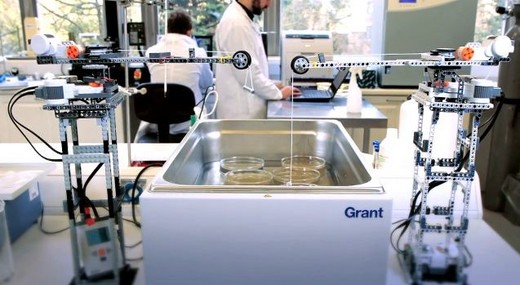
At England's Cambridge University, a small team of scientists are conducting experiments about bones, and how to make precise artificial bones. If they succeed, they can make artificial bone implants, and even building materials. However, there is one task that bores the scientists to death: putting a solid object like a bolt into a dish of calcium and protein, then in water, then in phosphate and protein. They then do this again and again. Then, a mechanical engineering PhD student decided to make a robot out of Lego to do the job for them.Because the robots don't need anything but energy, they can go on all night, so that samples are ready in the morning. They also have automatic programming, so it means that they don't have to be told to do anything again and again. It's like anything else natural: simple yet efficient.
I liked this post because of how creative and fun it makes science. I recommend looking further into this if you have a creative spirit and a lot of patience.

I liked this post because of how creative and fun it makes science. I recommend looking further into this if you have a creative spirit and a lot of patience.
The Sahara Desert Project:Its Becoming Real!
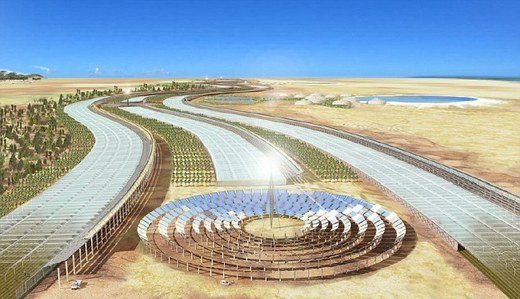
We all know that the Sahara Desert is...well a desert. The biggest. However, a project has finally come up to restore the trees to the land of Northern Africa, and turn it into an oasis.
 How does it work? The engineers and scientists have designed a greenhouse that draws water from the atmosphere and energy from the sun. While this sounds like something from a Sci-fi alien, it actually exists today. What happens is the sea water from the surrounding oceans/seas (Atlantic, Mediterranean, and Red Sea) is pumped to the greenhouses and then flows around the rooms in little pipes. What this causes is cool air. Now, with glass ceilings, heat comes into the greenhouse as light and condenses the cool air into humid air. Plants love humid air.Then comes the cool part. The walls of the greenhouse "catch air" and cause the humid air to condense. When it condenses, the condensed air becomes water droplets, which slide down the wall into a storage tank of fresh water. This can then be used to give plants cool, fresh water. Now I bet you're wondering "Alex, how does the air reach the walls? Air just rises and falls depending on the temperature!" Well, what happens is they installed fans to draw air through the greenhouse. Where do they get energy to power the fans? Concentrated Solar Energy! How that works is lots of mirrors direct sunlight to tanks filled with sea water, where it steams up, spins turbines and generates electricity. So, in a way, they designed a greenhouse that is solar/water powered!
I chose this topic because it was exciting to see people giving back to the environment in a positive way. And such a big way too! It seems out of this world, yet it seems right were it should be. I recommend looking at this article further if you truly care for this dying planet.


I chose this topic because it was exciting to see people giving back to the environment in a positive way. And such a big way too! It seems out of this world, yet it seems right were it should be. I recommend looking at this article further if you truly care for this dying planet.
Subscribe to:
Posts (Atom)